
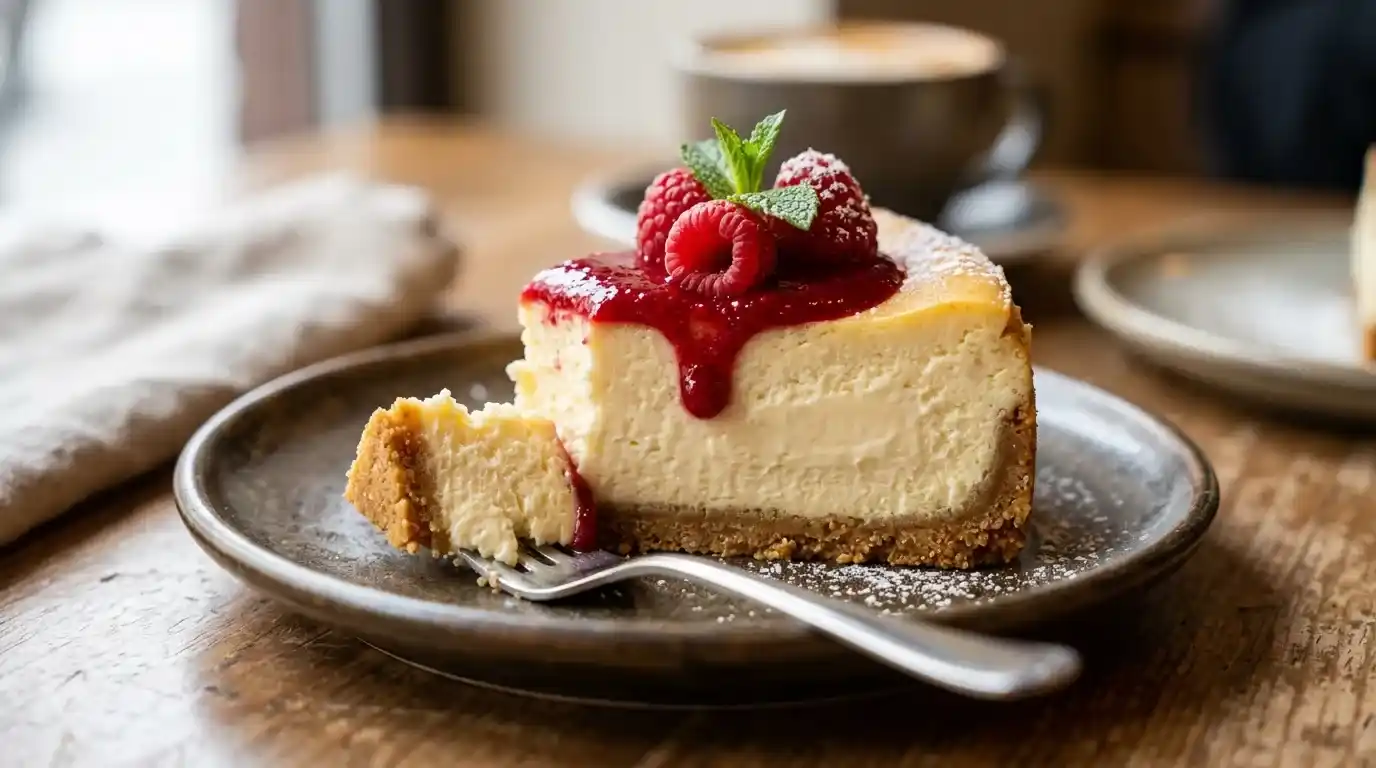
Creamy Cheesecake Recipe – Best No-Crack Method (Easy!)
My mother showed me how to make cheesecake when I was about twelve, and I spent the next twenty years trying to recreate her version without ever quite landing it. Creamy Cheesecake Recipe was the phrase I typed into search engines more times than I can count. Her version had a texture that was dense without being heavy — smooth all the way through with no cracks, no rubbery edge, no sunken centre. What she never told me, and what I eventually worked out, is that the oven does less work here than you think. The real technique happens before and after.
Here Is What I Do Differently Before You Start
Room temperature is not optional. Cold cream cheese does not blend smooth — it leaves lumps that no amount of mixing will fix once the eggs are in. Pull everything from the fridge at least 90 minutes before you start. This means the cream cheese, eggs, and sour cream.
Leave out the lemon zest — and I will stand behind this. Most cheesecake recipes call for it, and I understand why — it adds brightness. But it also introduces a competing flavour that mutes the dairy. Every person who eats this at our house remarks that it tastes cleaner and more purely of cream cheese than versions they have had elsewhere. One less ingredient is the reason.
Do not skip the water bath. It is the step people avoid most, and it is the one that matters most. Steam in the oven regulates the baking temperature and keeps the surface from setting faster than the centre — which is why cheesecakes crack.
Use full-fat everything. This is not a recipe where reduced-fat cream cheese or light sour cream produces a comparable result.
Why Creamy Cheesecake Recipe Works Here Is What I Do Differently
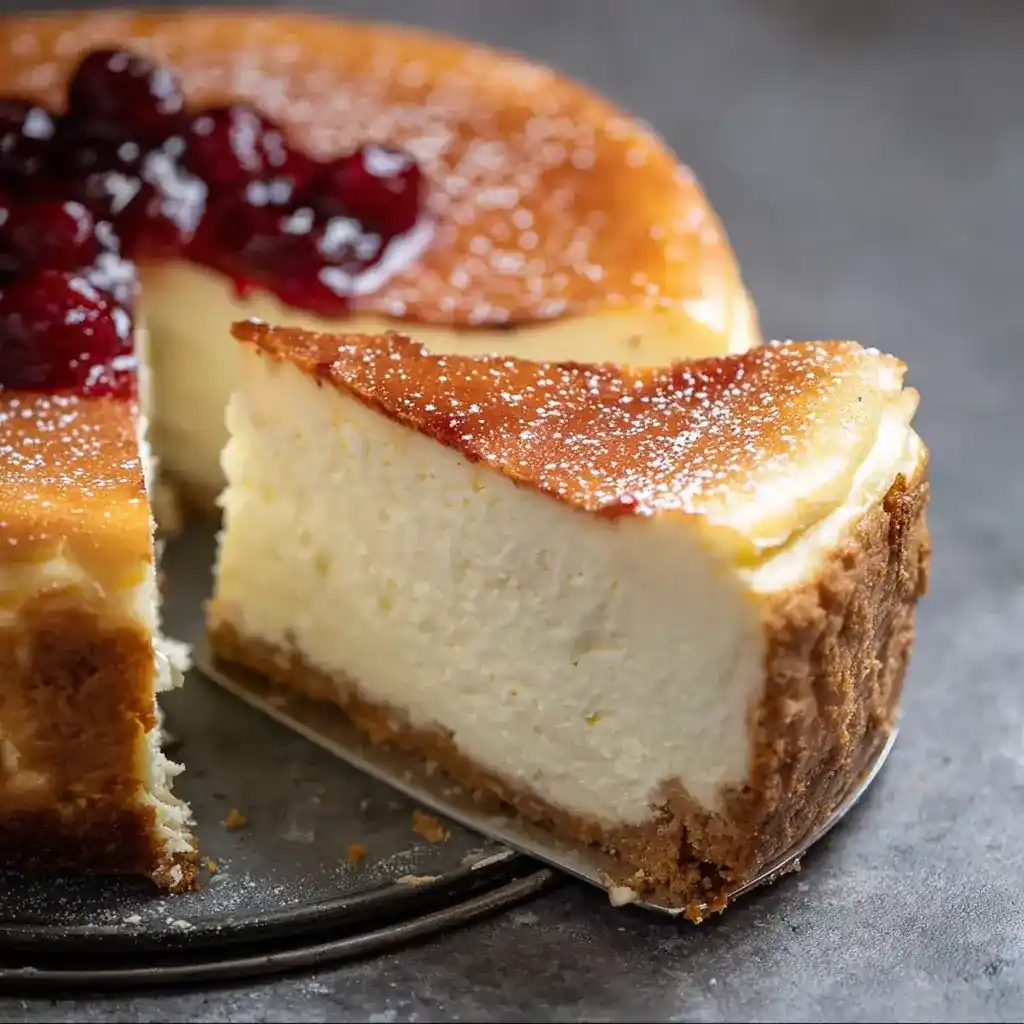
Creamy Cheesecake Recipe works here because the filling is built to stay below the temperature that makes eggs tighten. The water bath keeps the oven environment at or near 100°C / 212°F around the pan, regardless of what the dial is set to. That means the custard-like filling sets gently and evenly, which is why the texture is smooth rather than rubbery and why the surface does not split.
The second reason is the cooling method. Cheesecake does not finish baking when it comes out of the oven — it finishes cooling in the oven with the door ajar. A rapid temperature change causes the top to contract faster than the interior can follow, which opens cracks. Keeping the descent slow and gradual closes that gap. My mother did both of these things without explaining either of them. It took me two decades to understand why.
What You Need
For the Crust
- 200 g (7 oz / about 14 full sheets) digestive biscuits or graham crackers, finely crushed
- 75 g (5 tablespoons) unsalted butter, melted
- 2 tablespoons caster sugar
- Pinch of fine sea salt
For the Filling
- 900 g (2 lb / 4 blocks) full-fat cream cheese, at room temperature
- 200 g (1 cup) caster sugar
- 3 tablespoons plain flour
- 240 g (1 cup) full-fat sour cream, at room temperature
- 2 teaspoons pure vanilla extract
- 3 large eggs, at room temperature
- 1 large egg yolk, at room temperature
Optional: fresh berries, fruit compote, or a light dusting of icing sugar to serve
How to Make Creamy Cheesecake Recipe
Phase 1: Make the Crust
Creamy Cheesecake Recipe starts with a crust that has to be fully set before the filling goes in — a soft crust will absorb moisture during baking and turn soggy underneath.
- Heat your oven to 175°C / 155°C fan / 350°F. Wrap the outside of a 23 cm (9-inch) springform pan tightly in two layers of heavy-duty foil — this prevents water seeping in during the water bath.
- Mix the crushed biscuits, melted butter, sugar, and salt in a bowl until the crumbs look like damp sand and hold together when pressed.
- Press the mixture firmly and evenly into the base of the pan and about 2 cm (¾ inch) up the sides. Use the base of a glass to compact it — a loose, uneven crust will crumble when sliced.
- Bake the crust for 10 minutes until it smells toasted and looks set at the edges. Remove and cool on a rack while you make the filling. Reduce the oven to 160°C / 140°C fan / 325°F.
Phase 2: Make the Filling
- Beat the cream cheese on medium speed for 2 minutes until completely smooth. Scrape the bowl down twice — lumps at this stage will not resolve later.
- Add the sugar and flour. Beat on low for 1 minute until fully incorporated and the mixture looks uniform and slightly glossy.
- Add the sour cream and vanilla. Mix on low until just combined — the batter should look smooth and pourable, similar to thick cream.
- Add the eggs and egg yolk one at a time, mixing on low after each just until the yellow disappears. Do not over-mix after the eggs go in — excess air causes puffing and cracking.
- Tap the bowl on the counter five or six times to release any surface bubbles. Pour the filling over the cooled crust. The surface should look smooth and level.
Phase 3: Bake, Cool, and Set
Creamy Cheesecake Recipe finishes in a water bath — this step cannot be skipped if you want a smooth, crack-free surface.
- Place the foil-wrapped pan inside a larger roasting tin. Pour hot water into the roasting tin until it reaches halfway up the side of the springform pan — about 2–3 cm (1 inch).
- Bake at 160°C / 325°F for 55–65 minutes. The cheesecake is done when the edges are set and puffed slightly and the centre — roughly a 7 cm (3-inch) circle — still has a gentle wobble when the tin is nudged. It should not ripple like liquid.
- Turn the oven off. Leave the cheesecake inside with the door cracked open 5 cm (2 inches) for 1 hour. This slow descent prevents cracking.
- Remove from the oven and water bath. Run a thin knife around the inside edge of the pan to release the cheesecake from the sides — this also prevents cracking as it contracts. Cool at room temperature for 1 hour, then refrigerate uncovered for at least 6 hours, or overnight.
Here Is What to Do When Things Go Wrong
PROBLEM: Your Creamy Cheesecake Recipe has a large crack across the surface. CAUSE: The filling over-baked, the oven temperature was too high, or the cheesecake cooled too quickly. FIX: Next time, pull it when the centre still wobbles and cool it in the oven with the door ajar. If the crack has already happened, press it gently closed while the cheesecake is still warm; a topping will cover it completely once set.
PROBLEM: The texture is grainy or curdled rather than smooth. CAUSE: The cream cheese was cold when beaten, or the eggs were added too quickly and scrambled slightly. FIX: Always bring cream cheese to true room temperature — at least 90 minutes. Add eggs one at a time on low speed, not medium or high.
PROBLEM: The crust is wet and soft underneath after baking. CAUSE: Water seeped into the springform pan through the foil, or the foil layer was too thin. FIX: Use two layers of heavy-duty foil and press it firmly up the entire outside of the pan before water bathing. If water got in, the crust cannot be recovered — prevent it next time.
PROBLEM: The cheesecake sank in the centre after cooling. CAUSE: It was over-beaten after the eggs were added, which incorporated too much air that then collapsed. FIX: Once the eggs go in, mix only on low and only until each egg disappears. Stop the moment the batter looks uniform.
Here Is What I Do Differently With Storage
Cheesecake keeps refrigerated, loosely covered, for up to 5 days. Cover it only after it is fully cold — covering a warm cheesecake traps condensation and softens the surface.
To freeze, slice and place individual pieces on a parchment-lined tray. Freeze uncovered until solid, then wrap each slice in cling film and foil. Frozen cheesecake keeps for up to 2 months. Thaw overnight in the fridge — never at room temperature.
Questions I Get Asked Most Often
Does a cheesecake really need a water bath?
For a smooth, crack-free result, yes. The water bath is what keeps the oven temperature around the pan at a stable, low level — it physically cannot exceed 100°C / 212°F as long as water is present. Without it, the outer edge sets and dries before the centre can catch up, which causes both cracks and a rubbery texture near the edge. If you genuinely cannot use a water bath, place a separate shallow pan of hot water on the rack below the cheesecake as a partial substitute.
Why does my cheesecake always stick to the pan sides after baking?
It is releasing as it cools and contracting away from the sides — if the surface is stuck, the cheesecake will pull and crack. Running a thin, flexible knife around the inside edge immediately after it comes out of the oven — while still warm — solves this. Do this step even if the surface looks fine; the contraction happens as it cools.
Can I make this Creamy Cheesecake Recipe without a springform pan?
Technically you can bake a Creamy Cheesecake Recipe in a deep round cake tin lined with parchment, but removing it cleanly is significantly harder. A springform pan releases without pressure or cutting, which is what preserves the shape and the crust. If you must use a regular tin, line the base and sides with a single sheet of parchment with enough overhang to lift the cheesecake out once set.
How do I know when the cheesecake is done if I do not have an oven thermometer?
Look at the wobble, not the colour. The outer 5–6 cm (2 inches) should be fully set and slightly puffed. The inner circle — roughly the size of your palm — should wobble as one unit when the tin is nudged, not ripple in waves. If it ripples, it needs more time. If it is completely still and the surface has puffed evenly and looks dry, it has gone slightly too far — but not fatally so.
Estimated Nutrition Per Serving (serves 12)
| Nutrient | Per Serving |
|---|---|
| Calories | ~420 kcal |
| Total Fat | 30 g |
| Saturated Fat | 18 g |
| Carbohydrates | 31 g |
| Fibre | 0.5 g |
| Sugar | 22 g |
| Protein | 7 g |
| Sodium | 310 mg |
Figures are estimates. Values vary with exact ingredients and portion sizes.
Final Thoughts
My son finished the entire first slice I set out before I had lifted the knife a second time — and he is genuinely the least interested in food of anyone I live with. For him to go back for more without being asked told me that this Creamy Cheesecake Recipe had finally become what my mother’s was. If you tried skipping the flour in the filling and found it changed the texture in a way you preferred, I really want to know whether it held together as cleanly — leave me a note below.

The Best Creamy Cheesecake
Ingredients
Method
- Preheat oven to 160°C (320°F).
- Mix biscuit crumbs with melted butter until combined.
- Press the mixture into the bottom of a springform pan.
- Bake the crust for 10 minutes and let it cool.
- In a bowl, beat cream cheese and sugar until smooth.
- Add eggs one at a time, mixing well after each addition.
- Pour in heavy cream, vanilla extract, and lemon juice and mix until creamy.
- Pour the filling over the prepared crust.
- Bake for 50–60 minutes until the center is slightly set.
- Turn off oven and let cheesecake cool inside with door slightly open.
- Refrigerate for at least 4 hours before serving.
Video
Notes
- Do not overmix to avoid cracks.
- Use a water bath for extra creamy texture.
- Chill overnight for best results.
- Top with fruits or chocolate sauce before serving.