
Traditional Italian Christmas Cookies Recipe – Soft & Sweet
I found my grandmother Lucia’s recipe card tucked inside a bread cookbook last December, handwritten in pencil and barely legible after forty years. That discovery pushed me to finally make Traditional Italian Christmas Cookies Recipe properly — using her ricotta method instead of the butter-heavy version I had been making for years. The texture stopped me completely when I bit into the first one: soft like a cloud at the center but with enough structure to hold the icing without cracking. My aunt Rosa called them the closest thing she had tasted to the ones from Lucia’s kitchen since the eighties. The difference comes down to one ingredient most modern recipes quietly drop.
Why This Traditional Italian Christmas Cookies Recipe Works
Most versions skip the ricotta entirely and replace it with extra butter, which produces a cookie that is richer but denser and prone to spreading. The ricotta is what keeps this Traditional Italian Christmas Cookies Recipe soft for days rather than hours — it holds moisture inside the crumb without making the cookie wet or heavy. Other recipes fail the texture test by day two, turning dry and chalky. This one does not.
The second reason this works is the lemon zest in both the dough and the icing. It is a small addition but it ties the two layers together so the cookie tastes coherent rather than like two separate things stacked on top of each other. My own rule: always zest the lemon directly over the bowl so the oils land in the mixture rather than on the cutting board.

What You Need
For the Cookie Dough
- 3 cups (375g) all-purpose flour, spooned and levelled
- 1 tablespoon baking powder
- half teaspoon fine sea salt
- 225g (1 cup / 8 oz) whole-milk ricotta cheese, drained if watery
- 3 large eggs, at room temperature
- 1 cup (200g) white granulated sugar
- half cup (115g / 1 stick) unsalted butter, melted and cooled
- 2 teaspoons pure vanilla extract
- 1 tablespoon fresh lemon zest (from 1 large lemon)
For the Lemon Icing
- 2 cups (240g) powdered sugar, sifted
- 3 tablespoons (45ml) fresh lemon juice
- 1 teaspoon fresh lemon zest
- 1 tablespoon (15ml) whole milk, plus more to thin if needed
Optional: coloured nonpareils, rainbow sprinkles, edible pearl sugar for decorating
How to Make Traditional Italian Christmas Cookies Recipe Step by Step
Step 1 — Make and Rest the Dough (15 minutes plus 30 minutes chill)
The first stage of this Traditional Italian Christmas Cookies Recipe is building a dough that scoops cleanly without sticking. Whisk the flour, baking powder, and salt together in a large bowl until the mixture looks uniform and pale. In a separate bowl, beat the ricotta, eggs, sugar, melted butter, vanilla, and lemon zest until the mixture is smooth and slightly glossy.
Pour the wet ingredients into the dry and fold gently with a spatula. Stop when no dry streaks remain — the dough will look soft and slightly shaggy, not stiff. Cover the bowl and refrigerate for thirty minutes; chilled dough holds its round shape during baking.
Step 2 — Scoop and Bake (12 minutes)
Preheat your oven to 180°C / 350°F and line two baking sheets with parchment paper. Scoop the dough into balls using a tablespoon measure — each ball should be about the size of a large grape, roughly 25g. Space them five centimetres apart on the tray; they puff upward more than they spread outward.
Bake for eleven to twelve minutes. The edges will look just set and the tops will appear barely colored — almost white still. Pull them at this point even if they look underdone. They firm up completely on the tray as they cool, and overbaking is the main reason these cookies turn dry.
Step 3 — Ice and Decorate (10 minutes)
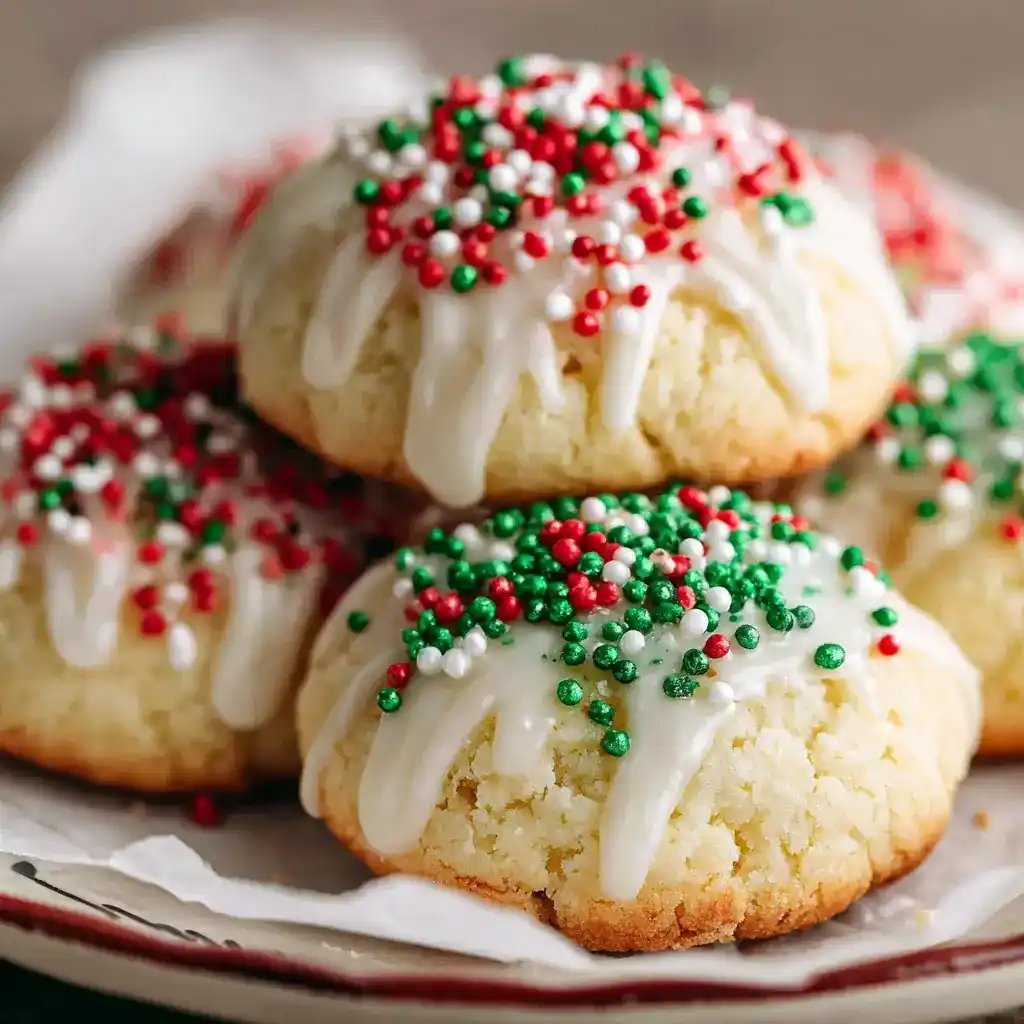
The icing stage is what makes this Traditional Italian Christmas Cookies Recipe look finished rather than plain. Whisk together the powdered sugar, lemon juice, lemon zest, and milk until completely smooth — the icing should drip slowly off a spoon, like a thick glaze, not run freely.
Dip the flat top of each cooled cookie into the icing and lift with a slight twist. You should see a clean, even white layer that holds its shape without dripping down the sides. Add sprinkles or nonpareils immediately before the icing sets, which happens in about five minutes at room temperature.
Three Things That Make This Better
Drain your ricotta the night before. Even whole-milk ricotta varies in water content by brand. Place it in a fine mesh strainer over a bowl in the fridge overnight and discard the liquid that collects. I skipped this once with a particularly wet brand and ended up with dough that spread into flat discs rather than domed rounds.
Add the lemon zest before the sugar in the icing. Rubbing the zest into the powdered sugar with your fingers for thirty seconds before adding the liquid releases the lemon oils into the sugar crystals. The finished icing has a noticeably brighter citrus note than when you simply mix everything together at once — a technique a pastry cook showed me years ago.
Pull the cookies two minutes early and let the tray finish them. These cookies look underdone when they are actually perfect. The carry-over heat from the hot baking sheet continues cooking the bases for several minutes after you take them from the oven. Waiting for obvious browning means you have already gone two minutes too far.
When Something Goes Wrong
PROBLEM: The Traditional Italian Christmas Cookies Recipe produced flat, spread-out cookies rather than domed rounds. CAUSE: The dough was not chilled before baking, or the ricotta was too wet and added excess moisture. FIX: Always chill the dough for at least thirty minutes, and drain the ricotta if it releases any liquid in the strainer.
PROBLEM: The icing cracked after setting and fell off the tops of the cookies. CAUSE: The icing was too thick or the cookies were not fully cooled before dipping. FIX: Thin the icing with milk one teaspoon at a time and confirm cookies are at full room temperature — warm cookies make the icing slide rather than set.
PROBLEM: The cookies turned hard and dry by the second day after baking. CAUSE: They were overbaked by even two to three minutes, driving out the moisture the ricotta was providing. FIX: Pull them at eleven minutes and trust the cool-down process to finish them — store in a sealed container with a piece of bread to maintain moisture.
PROBLEM: The dough was too sticky to scoop cleanly, leaving messy blobs on the tray. CAUSE: The dough had warmed up during scooping as the kitchen was warm or the rest period was too short. FIX: Work in batches — keep the remaining dough in the fridge while you scoop one tray at a time, and refrigerate the scooped tray for ten minutes before baking if the kitchen is above 22°C.
Ways to Change This Recipe
No lemon? Use orange zest and fresh orange juice in both the dough and icing for a slightly sweeter citrus note.
Want it richer? Add two tablespoons of almond flour to the dry ingredients and one teaspoon of almond extract in place of half the vanilla.
For a gluten-free version: substitute a 1:1 gluten-free baking flour blend at the same quantity and add half a teaspoon of xanthan gum if the blend does not already contain it.
No ricotta? Substitute full-fat sour cream at the same weight — the texture will be slightly denser but the softness largely holds.
Want it spiced? Add half a teaspoon each of cinnamon and ground anise seed to the dry ingredients for a more traditional holiday flavor profile.
Storage: Iced cookies keep in a single layer in an airtight container at room temperature for up to five days. Layer between sheets of parchment if stacking is necessary to prevent the icing from sticking. Uniced baked cookies freeze well for up to two months — ice them after thawing.
Questions About This Recipe
Why does my icing look streaky and uneven after it sets?
Streaky icing usually means the powdered sugar was not fully sifted before mixing, leaving small lumps that drag during dipping. Sift the sugar into the bowl rather than adding it straight from the bag. Whisking for a full minute after adding the liquid also helps — the icing should look glossy and completely smooth before you start dipping.
Can I freeze the raw dough and bake it later?
Yes, and it works well. Scoop the dough into balls first, freeze them on a lined tray until solid, then transfer to a sealed bag. Bake from frozen at 180°C / 350°F for fourteen to fifteen minutes — add two to three minutes to the standard time. Ice after they have cooled completely, the same as fresh-baked.
How far ahead can I make Traditional Italian Christmas Cookies Recipe for the holidays?
This Traditional Italian Christmas Cookies Recipe holds up well when made three to four days before serving. Bake and ice them, then store in a sealed container at room temperature with a piece of white bread tucked in to maintain softness. The texture on day three is often even better than day one, once the moisture has redistributed through the crumb.
The tops of my cookies look bumpy and uneven after baking — what went wrong?
Bumpy tops usually come from undermixing the wet and dry ingredients, leaving small pockets of unmixed flour that puff unevenly in the oven. Fold the dough until it is fully uniform with no visible dry streaks, then scoop immediately before the mixture tightens further. Smooth each ball lightly between your palms before placing on the tray for a cleaner dome shape.
Closing
What pulls me back to these every December is the icing dip — the moment the cookie top meets the glaze and you lift it away with that clean white coat. This Traditional Italian Christmas Cookies Recipe is the one I make in batches of three dozen because one dozen disappears before they are properly cooled. My aunt Rosa always said they improve overnight — if yours made it that far, I want to know whether you agreed, or whether they were gone the same day too.
ESTIMATED NUTRITION PER SERVING
(per 1 cookie, based on 36 cookies)
| Nutrient | Amount |
|---|---|
| Calories | ~110 kcal |
| Total Fat | 3.5g |
| Saturated Fat | 2g |
| Carbohydrates | 18g |
| Fibre | 0.3g |
| Sugar | 11g |
| Protein | 2.5g |
| Sodium | 65mg |
Figures are estimates. Values vary with exact ingredients.

Traditional Italian Christmas Cookies
Ingredients
Method
- Preheat oven to 180°C (350°F) and line a baking tray with parchment paper.
- In a bowl, whisk together flour and baking powder.
- In another bowl, cream butter and sugar until light and fluffy.
- Add eggs one at a time, mixing well after each addition.
- Stir in vanilla extract and almond extract.
- Gradually add dry ingredients and mix into a soft dough.
- Shape small portions of dough into balls or twists.
- Place cookies on the baking tray with spacing between them.
- Bake for 12–15 minutes until lightly golden.
- Remove and cool completely on a rack.
- Mix powdered sugar and milk to make a glaze.
- Drizzle glaze over cooled cookies and add sprinkles.
Video
Notes
- Do not overbake to keep cookies soft.
- Add lemon zest for extra flavor variation.
- Store in an airtight container for up to 5 days.
- Perfect for holiday gifting and festive occasions.