Chocolate Chip Cookie Dough Cheesecake (Ultimate Recipe)
I had leftover cheesecake and cookie dough ingredients sitting in the fridge on a Sunday evening and needed to use them before they went bad. Chocolate Chip Cookie Dough Cheesecake was the result — and it turned out better than either component would have been on its own. The first attempt had a crust that softened under the filling and a top that split down the centre. By the third version I had solved both problems and had not changed either since. What follows is the version that works, with every decision explained.
How to Start Without the Problems — What to Check Before You Begin
Bring everything to room temperature properly. Cold cream cheese does not blend smooth — it creates tiny lumps that no amount of mixing will remove once the eggs are in. The cream cheese needs at least 90 minutes out of the fridge. Eggs need 30 minutes. Do not rush this.
Leave out the vanilla in the cheesecake filling — and I will stand behind this. Almost every version of this recipe calls for vanilla extract in both the cookie dough and the filling. I stopped adding it to the filling and the result was cleaner — the cream cheese flavour came through more directly, and the vanilla in the cookie dough layer had somewhere to be distinct. Every person who eats this here asks what makes the filling taste different. One less ingredient is the answer.
Use heat-treated flour in the cookie dough. Raw flour can carry bacteria. Spread it on a baking sheet and bake at 175°C / 350°F for 5 minutes, then cool before using. It changes nothing about the texture but makes the dough safe to eat unbaked.
Wrap the springform pan in two layers of heavy-duty foil before water bathing. A single layer lets water seep in. Wet crusts cannot be fixed after baking.
How Chocolate Chip Cookie Dough Cheesecake Works Without Compromising Either Layer
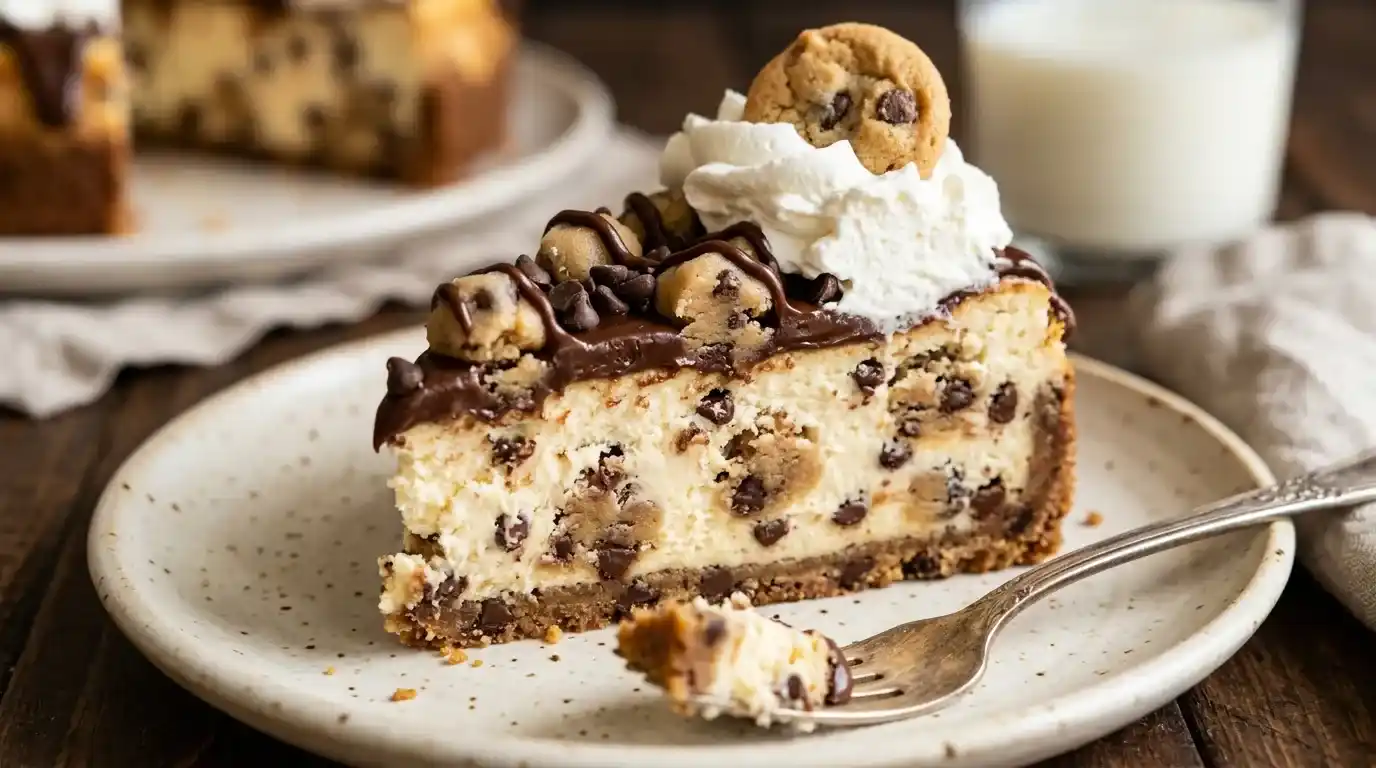
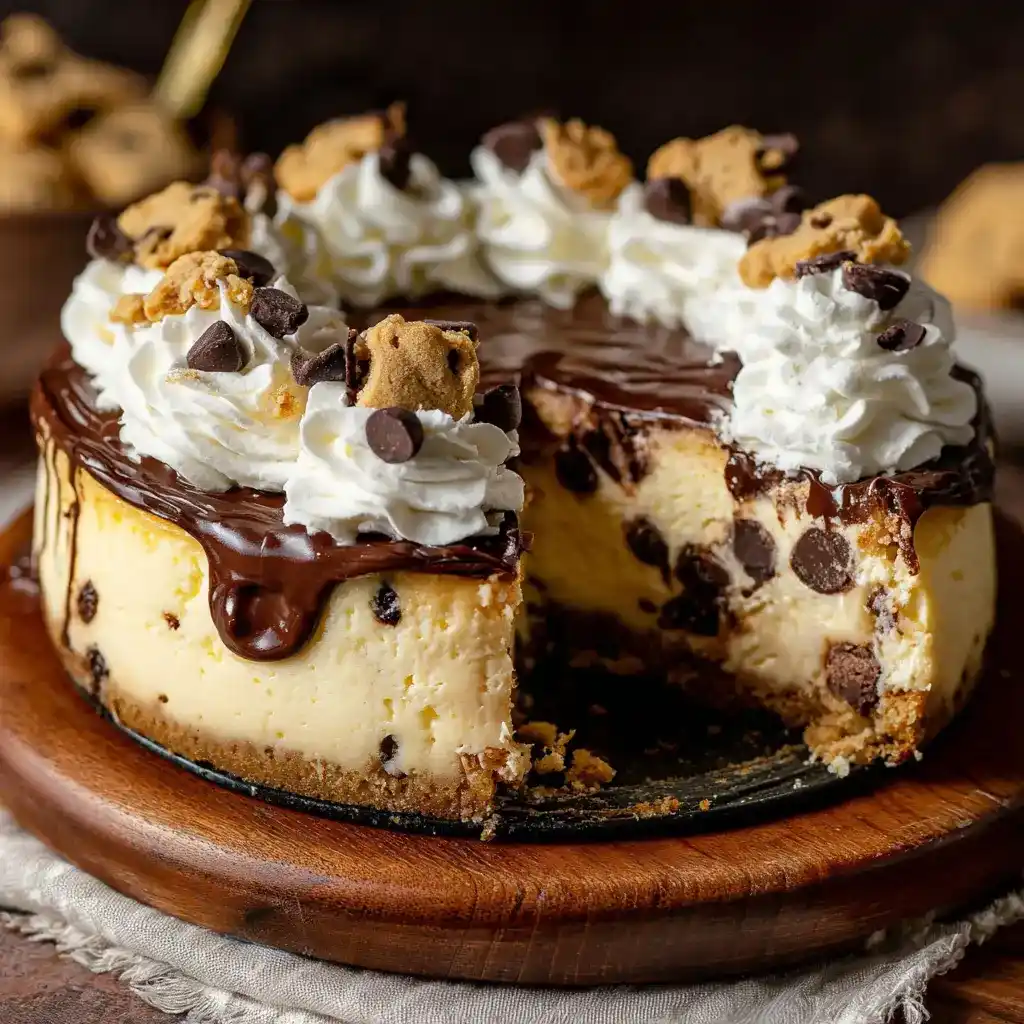
Chocolate Chip Cookie Dough Cheesecake holds two structurally different things together without one overwhelming the other because the cookie dough is not baked — it is set. The dough goes in cold and firm, folded through a filling that is dense enough to suspend it in place. During baking the cheesecake sets around the dough pieces rather than absorbing them, which is why you still get distinct pockets of cookie dough in the finished slice.
The second reason is the crust. A standard digestive biscuit base saturates with moisture when a wet filling sits on it for hours. Pre-baking the crust for 10 minutes before adding the filling creates a sealed layer that resists absorption. The texture difference at the base of the slice is the result of that single step.
What You Need
For the Crust
- 220 g (7.5 oz / about 15 full sheets) digestive biscuits or graham crackers, finely crushed
- 85 g (6 tablespoons) unsalted butter, melted
- 2 tablespoons caster sugar
- Pinch of fine sea salt
For the Egg-Free Cookie Dough
- 125 g (1 cup) plain flour, heat-treated (see Before You Start)
- 115 g (½ cup / 1 stick) unsalted butter, at room temperature
- 100 g (½ cup, packed) light brown sugar
- 2 tablespoons caster sugar
- 2 tablespoons whole milk
- 1 teaspoon pure vanilla extract
- ½ teaspoon fine sea salt
- 150 g (5 oz / 1 cup) mini chocolate chips
For the Cheesecake Filling
- 675 g (1½ lb / 3 blocks) full-fat cream cheese, at room temperature
- 175 g (¾ cup) caster sugar
- 3 tablespoons plain flour
- 180 g (¾ cup) full-fat sour cream, at room temperature
- 3 large eggs, at room temperature
- 1 large egg yolk, at room temperature
For the Topping
- 75 g (2.5 oz / ½ cup) mini chocolate chips
- 60 g (2 oz) reserved cookie dough, crumbled into small pieces
Optional: caramel sauce drizzle, flaky salt finish
How to Make Chocolate Chip Cookie Dough Cheesecake — Without Soggy Crust or Cracked Filling
Phase 1: Crust and Cookie Dough
Chocolate Chip Cookie Dough Cheesecake starts with two components built separately before the filling is made — doing them in the wrong order wastes time and creates problems.
- Heat oven to 175°C / 155°C fan / 350°F. Wrap the outside of a 23 cm (9-inch) springform pan tightly in two layers of heavy-duty foil, pressing it firmly up the sides.
- Mix the crushed biscuits, melted butter, sugar, and salt in a bowl until the mixture resembles damp sand and holds together when pressed. Press firmly into the base of the pan and about 2 cm up the sides.
- Bake the crust for 10 minutes until it smells lightly toasted and feels set at the edges. Remove and cool on a wire rack. Reduce oven to 160°C / 140°C fan / 325°F.
- While the crust cools, make the cookie dough. Beat the butter and both sugars together until pale and fluffy — about 2 minutes. Add the milk, vanilla, and salt. Mix until smooth.
- Add the heat-treated flour and mix on low until just combined. Fold in the mini chocolate chips. Reserve 60 g (2 oz) of the dough for the topping. Refrigerate the rest in a bowl while you make the filling.
Phase 2: Cheesecake Filling
- Beat the cream cheese on medium speed for 2 full minutes until completely smooth, scraping the bowl twice. Any remaining lumps will not resolve once the eggs are added.
- Add the sugar and flour. Beat on low for 1 minute until fully incorporated and the mixture looks uniform.
- Add the sour cream and mix on low until smooth. The batter should look thick and slightly glossy at this point — no streaks of white.
- Add the eggs and egg yolk one at a time on low speed, mixing only until each one disappears. Do not over-mix after the eggs go in — excess air causes puffing and cracking during baking.
- Remove the chilled cookie dough from the fridge. Break it into rough pieces about 1–2 cm (½ inch) across. Fold gently into the cheesecake batter with a spatula — 6 to 8 folds only. Uneven distribution is fine; over-folding breaks the dough into the filling.
- Pour the combined filling over the cooled crust. Tap the pan on the counter 5 times to release surface bubbles. The top should look smooth and level.
Phase 3: Bake, Cool, and Top
Chocolate Chip Cookie Dough Cheesecake requires a water bath — this is what separates a smooth surface from a cracked one.
- Set the foil-wrapped pan inside a larger roasting tin. Pour hot water into the roasting tin until it reaches halfway up the side of the springform pan.
- Bake at 160°C / 325°F for 60–70 minutes. The cheesecake is done when the outer 5 cm (2 inches) are set and the centre — about a 7 cm circle — wobbles gently as one unit when nudged. It should not ripple like liquid.
- Turn the oven off. Leave the cheesecake inside with the door ajar by 5 cm (2 inches) for 1 hour. This slow temperature drop prevents surface cracking.
- Remove from the oven. Run a thin knife around the inside edge of the pan. Cool at room temperature for 1 hour, then refrigerate uncovered for at least 6 hours or overnight.
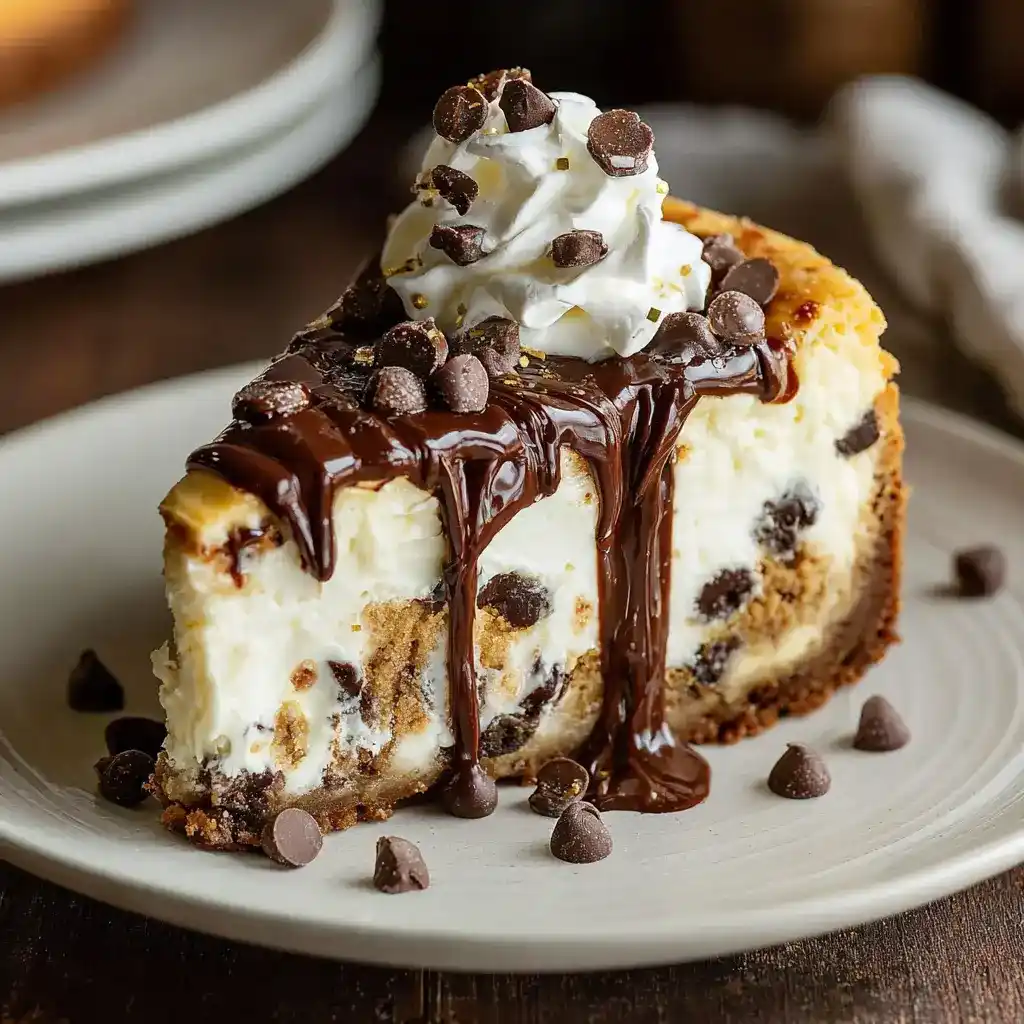
- Before serving, scatter the mini chocolate chips and reserved crumbled cookie dough pieces across the top. Press them gently so they adhere.
How to Fix It — Without Repeating the Same Mistakes
PROBLEM: Your Chocolate Chip Cookie Dough Cheesecake has a wet, soggy crust that collapses when sliced. CAUSE: The crust was not pre-baked before the filling was added, or water seeped through insufficient foil during the water bath. FIX: Always pre-bake the crust for 10 minutes and let it cool completely before adding filling. Use two layers of heavy-duty foil and press them firmly around the entire outside of the pan.
PROBLEM: The cookie dough dissolved into the filling and there are no distinct dough pockets in the finished slice. CAUSE: The dough was too soft when folded in, or it was over-folded and broke apart into the batter. FIX: Refrigerate the dough for at least 30 minutes before folding it into the filling. Use no more than 8 broad folds. Cold, firm pieces of dough hold their shape through baking; room-temperature dough dissolves.
PROBLEM: The surface has a large crack running across it. CAUSE: The cheesecake over-baked, the oven temperature was too high, or it cooled too quickly when removed from the oven. FIX: Pull it when the centre still wobbles. Leave it in the turned-off oven for 1 hour with the door ajar — the gradual cooling is what keeps the surface intact.
PROBLEM: The filling has a grainy or curdled texture rather than smooth. CAUSE: The cream cheese was cold when beaten, or the eggs went in too fast on too high a speed. FIX: Room temperature means at least 90 minutes out of the fridge, not 15. Add eggs one at a time on the lowest speed setting.
How to Store It Without Losing Texture
Refrigerate covered for up to 5 days. Cover only after the cheesecake is fully cold — covering a warm surface traps condensation and softens the topping.
Freeze individual slices by placing them on a parchment-lined tray uncovered until solid, then wrapping in cling film and foil. Freeze up to 2 months. Thaw overnight in the fridge. Add fresh cookie dough crumbles and chocolate chips to the top after thawing — the topping does not freeze well.
Estimated Nutrition Per Serving (serves 12)
| Nutrient | Per Serving |
|---|---|
| Calories | ~510 kcal |
| Total Fat | 32 g |
| Saturated Fat | 19 g |
| Carbohydrates | 50 g |
| Fibre | 1 g |
| Sugar | 34 g |
| Protein | 7 g |
| Sodium | 340 mg |
Figures are estimates. Values vary with exact ingredients and portion sizes.
Questions People Ask About This One
Does the cookie dough need to be egg-free if it’s going inside a baked cheesecake?
The dough pieces do not reach a temperature during baking that would reliably make raw eggs safe — the cheesecake bakes gently and the dough pockets stay relatively cool at the centre. Using egg-free dough with heat-treated flour removes that concern entirely and does not affect the texture. If you use raw flour, bake it first on a sheet pan at 175°C / 350°F for 5 minutes and cool before using.
Can I skip the water bath if I do not have a roasting tin large enough?
You can, but expect a higher chance of surface cracking and a denser texture near the edge. The closest workaround is to place a shallow ovenproof pan filled with hot water on the rack below the cheesecake while it bakes. This creates steam without submerging the pan. It is not as effective as a true water bath, but it reduces cracking compared to baking with no moisture at all.
Can I make Chocolate Chip Cookie Dough Cheesecake without a springform pan?
A springform pan is strongly recommended for this — releasing Chocolate Chip Cookie Dough Cheesecake from a standard cake tin without breaking the crust is genuinely difficult given the weight and softness of the filling. If a springform is not available, line a deep round tin with parchment leaving significant overhang on all sides, and lift the cheesecake out using the parchment after it has set completely in the fridge. The shape will be less precise but the result is otherwise identical.
My cookie dough pieces all sank to the bottom of the filling during baking — how do I prevent that?
The dough pieces were either too large or not cold enough when they went into the batter. Pieces larger than 2 cm will sink because the filling cannot hold them in suspension. Keep pieces at 1–2 cm maximum and refrigerate the dough for at least 30 minutes before folding it in. Fold gently — just enough to distribute — so the pieces stay distinct and do not break into smaller fragments that sink more easily.
Closing
My son finished the entire first slice before I had lifted the server a second time — and he is genuinely not someone who pays attention to what he is eating. For him to reach back without being asked told me everything I needed to know about Chocolate Chip Cookie Dough Cheesecake. If you tried pressing whole cookie dough balls into the top before baking rather than folding diced pieces through the filling, I really want to know whether they held their shape or spread into the surface — leave me a note below.

Chocolate Chip Cookie Dough Cheesecake
Ingredients
Method
- Preheat oven to 325°F (160°C).
- Mix graham cracker crumbs and melted butter, then press into the base of a springform pan.
- Bake crust for 8–10 minutes and let it cool.
- Beat cream cheese and sugar until smooth and creamy.
- Add eggs one at a time, mixing gently after each addition.
- Mix in vanilla extract and sour cream until fully combined.
- Fold in chocolate chips and small chunks of edible cookie dough.
- Pour batter over the prepared crust and smooth the top.
- Bake for 50–60 minutes until center is slightly set.
- Turn off oven and let cheesecake cool inside with door slightly open.
- Refrigerate for at least 4 hours before slicing and serving.
Video
Notes
- Use egg-free cookie dough for safe consumption.
- Avoid overmixing to prevent cracks in cheesecake.
- Chill overnight for best texture and flavor.
- Add chocolate drizzle or whipped cream before serving for extra richness.