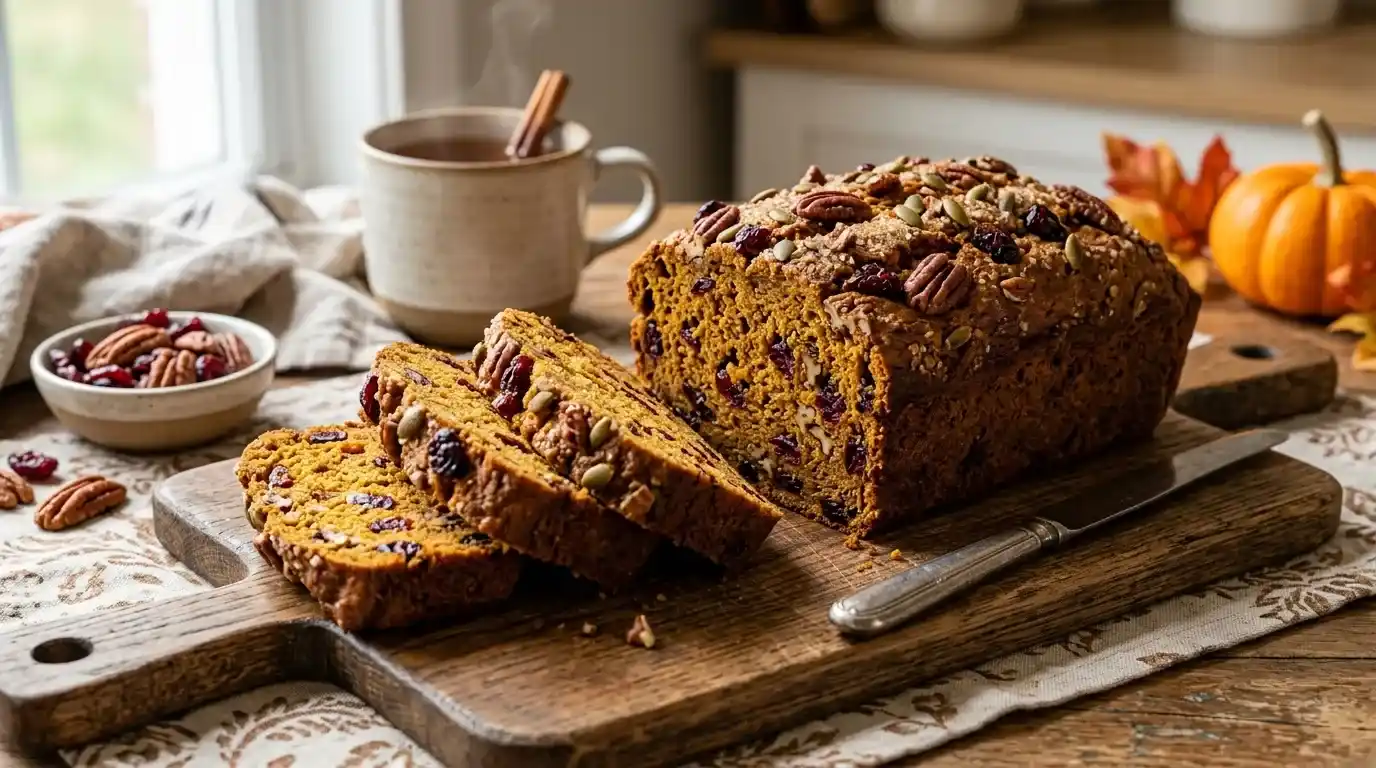
Cranberry Pecan Pumpkin Bread – Moist & Easy Recipe
My daughter turned thirteen last July and asked for a special dinner, so I finished the evening by attempting something I had never baked before. Cranberry Pecan Pumpkin Bread was her request — specific, with no room to substitute something simpler. The first loaf was dense and sunken in the centre, the cranberries all sank to the bottom, and the pecan layer on top burned before the inside had set. Three loaves later I had worked out what the recipes I had been following were not telling me. Everything I learned is in this article.
Here Is What I Do Differently Before You Start
Measure the pumpkin purée carefully. Too much and the batter becomes too wet to bake through before the crust over-colours. Use exactly the quantity given — 240 g / 1 cup — and blot the purée with a paper towel if it looks unusually watery. Canned pumpkin varies between brands.
Leave out the cloves — and I will stand behind this. Most pumpkin bread recipes include ground cloves alongside the cinnamon and ginger. Cloves are pungent and forward; in a loaf with the sharpness of fresh cranberries, they push the whole thing in an aggressive direction. Without them, the spice sits behind the fruit and the nut rather than over it. Everyone who eats this here asks what makes the spice feel cleaner than other versions. The answer is one less ingredient.
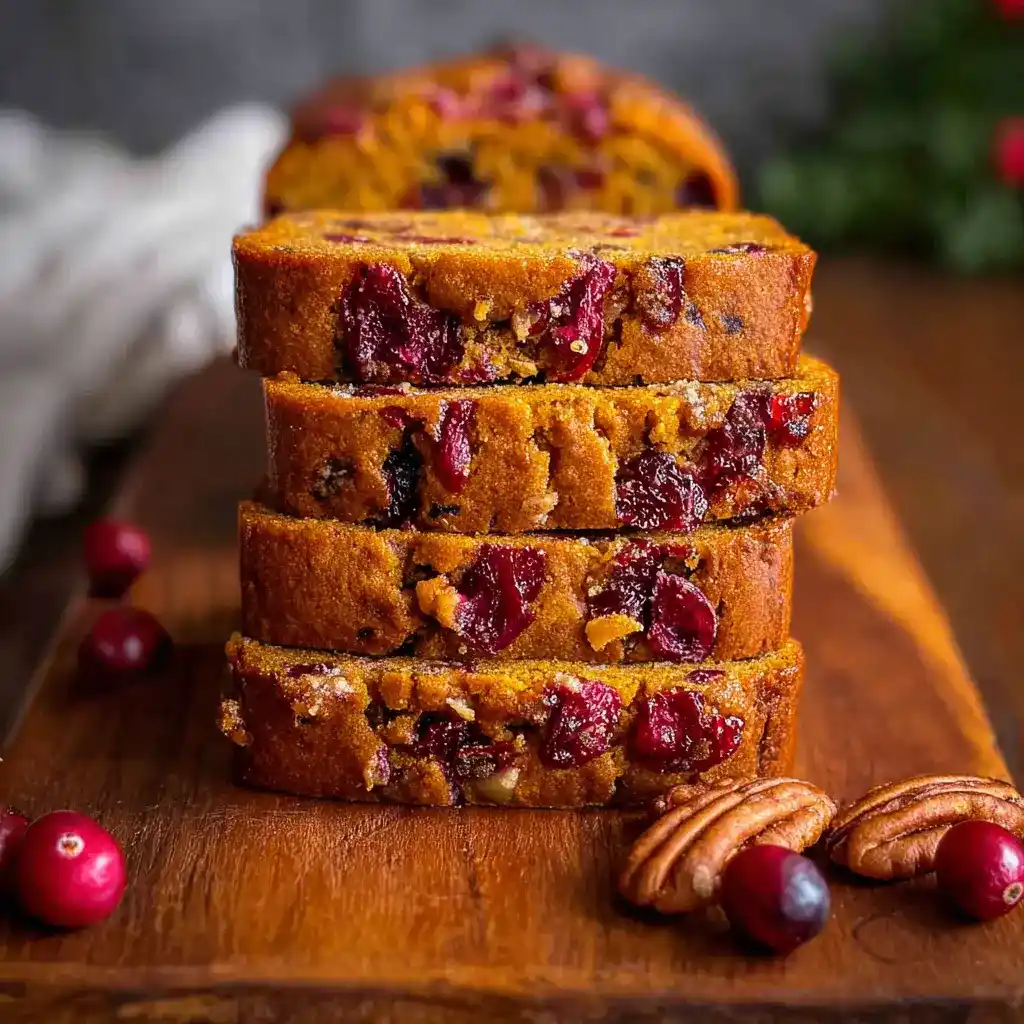
Toss the cranberries in flour before folding them in. One tablespoon of flour coats each berry and gives the batter something to grip — this is what keeps them suspended through the loaf rather than sinking to the base during the first ten minutes of baking.
Cover the top loosely with foil at the 35-minute mark. The pecan topping colours fast. Foil keeps it from burning while the centre finishes.
Why Cranberry Pecan Pumpkin Bread Works Here Is What I Do Differently
Cranberry Pecan Pumpkin Bread holds its structure through a long bake because the oil-based batter retains moisture without steaming. Butter-based quick breads can over-soften the crumb — oil does not. The result is a loaf that slices cleanly on day one and stays tender on day three, which butter versions rarely manage at this level of hydration.
The second reason is the brown sugar. Caster sugar produces a paler, slightly drier crumb in quick breads. Brown sugar adds hygroscopic molasses — it actively holds moisture — and that is why the interior of this loaf feels soft rather than dry even after the cranberry juice has released during baking. The two sugars in this recipe are not interchangeable by weight without affecting the outcome.
What You Need
For the Loaf
- 240 g (1 cup) canned pumpkin purée (not pumpkin pie filling)
- 160 ml (⅔ cup) neutral oil (vegetable or light olive)
- 150 g (¾ cup, packed) light brown sugar
- 50 g (¼ cup) caster sugar
- 2 large eggs, room temperature
- 1 teaspoon pure vanilla extract
- 250 g (2 cups) plain flour, plus 1 tablespoon for dusting cranberries
- 1 teaspoon bicarbonate of soda
- 1½ teaspoons ground cinnamon
- ½ teaspoon ground ginger
- ¼ teaspoon freshly grated nutmeg
- ½ teaspoon fine sea salt
- 150 g (5 oz / 1 cup) fresh or frozen cranberries, halved if large
For the Pecan Topping
- 60 g (½ cup) pecan halves, roughly broken
- 1 tablespoon light brown sugar
- ½ teaspoon ground cinnamon
- Pinch of fine sea salt
Optional: a dusting of icing sugar once fully cooled
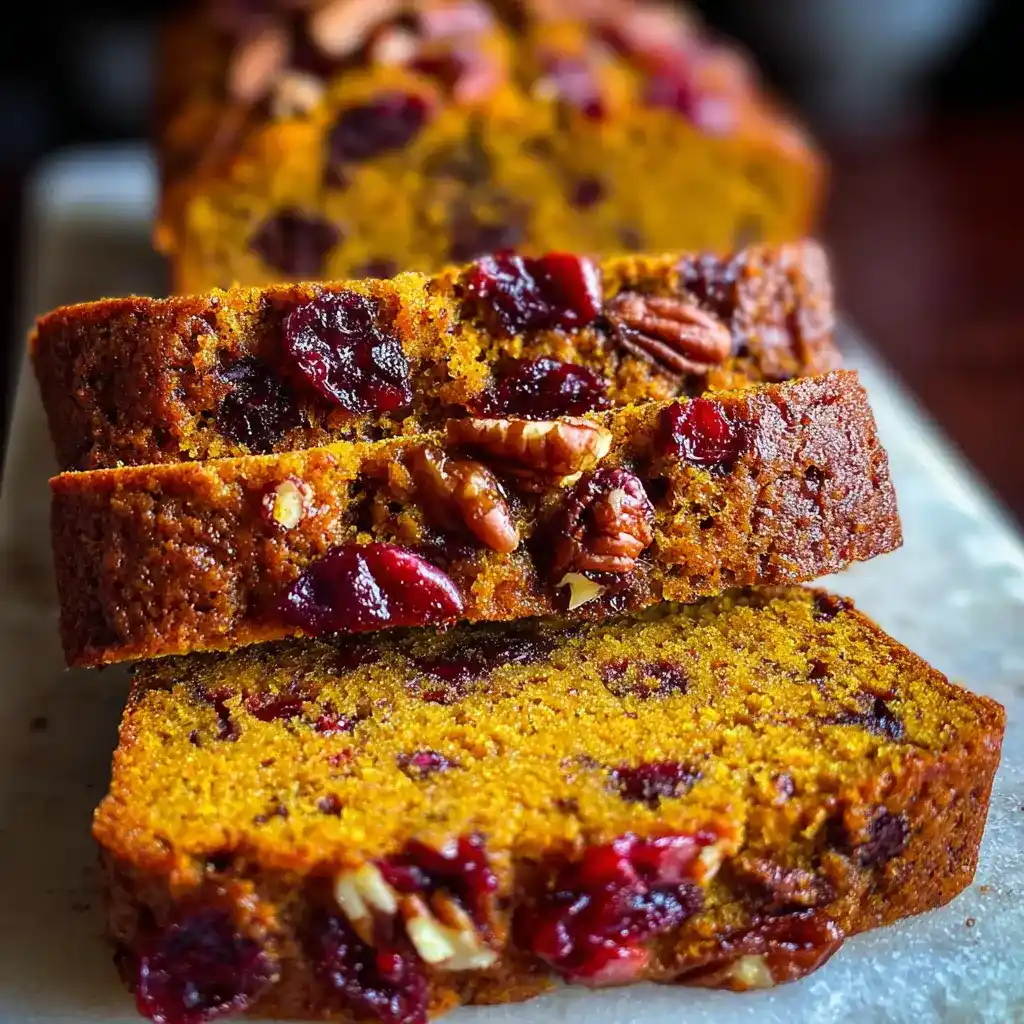
How to Make Cranberry Pecan Pumpkin Bread
Phase 1: Mix the Batter
Cranberry Pecan Pumpkin Bread starts with the wet ingredients — combine them fully before any flour goes in to avoid streaks of dry mix through the finished loaf. Heat your oven to 175°C / 155°C fan / 350°F. Grease a 23 x 13 cm (9 x 5 inch) loaf tin and line it with a strip of parchment that overhangs the long sides — this is your handle for lifting the loaf out cleanly.
Whisk together the pumpkin purée, oil, both sugars, eggs, and vanilla in a large bowl until the mixture is smooth and a deep amber-orange, with no visible streaks of egg white. The consistency should be slightly thicker than double cream — pourable but not runny. In a separate bowl, whisk the flour, bicarbonate of soda, cinnamon, ginger, nutmeg, and salt until evenly combined.
Pour the dry ingredients into the wet bowl. Fold with a spatula using slow, wide strokes — no more than 15 folds. The batter should look just combined; a few faint flour streaks are fine. Over-mixing develops gluten and produces a tunnelled, rubbery crumb.
Phase 2: Add the Cranberries and Top
Toss the halved cranberries in the reserved tablespoon of flour until each one is lightly coated — shake off the excess. Fold the floured cranberries into the batter using 6 to 8 gentle strokes. They should be evenly distributed but not broken down. Pour the batter into the prepared tin and smooth the top level with the back of a spoon. The tin should be about two-thirds full; any more and the loaf will dome and crack unevenly.
Mix the pecans, brown sugar, cinnamon, and salt in a small bowl until the nuts are coated. Scatter the pecan mixture evenly across the surface of the batter — press each piece lightly so it sits just in the surface rather than on top of it. Pieces that sit too proud will burn before the loaf is done.
Phase 3: Bake and Cool
Cranberry Pecan Pumpkin Bread needs a long, steady bake at moderate heat — do not rush it with higher temperature. Bake for 55–65 minutes total. At the 35-minute mark, lay a sheet of foil loosely over the top without pressing it down — this protects the pecan topping while the centre finishes baking. The loaf is done when a skewer inserted into the centre comes out with just a few moist crumbs attached. The top should be set and the sides will have begun pulling away from the tin slightly.
Leave the loaf in the tin for 15 minutes before lifting it out using the parchment overhang. The loaf needs this rest — cut into it too early and the crumb will be gummy and will pull apart. Transfer to a wire rack and cool for at least 1 hour before slicing. The interior continues to set as it cools, and slicing too soon wastes the texture the slow bake created.
Here Is What to Do When Things Go Wrong
PROBLEM: Your Cranberry Pecan Pumpkin Bread sank in the centre after cooling. CAUSE: The loaf was under-baked at the centre, or the oven temperature was too high, causing the outside to set before the middle had cooked through. FIX: Test with a skewer at the deepest point — it should come out with just a few moist crumbs, not wet batter. Lower your oven temperature by 10 degrees and extend the bake time if the outside is colouring faster than the inside is cooking.
PROBLEM: All the cranberries sank to the bottom and the top half of the loaf has none. CAUSE: The cranberries were not floured before folding in, or the batter was too thin to support them. FIX: Always toss cranberries in flour first. If the batter looks very loose, the pumpkin purée may have been wetter than usual — blot it with paper towel before measuring next time.
PROBLEM: The pecan topping burned before the loaf was fully baked. CAUSE: The foil was not placed over the tin early enough, or the oven runs hot at the top. FIX: Place foil over the tin at 35 minutes without fail, even if the topping looks pale — it colours quickly in the final stretch. If your oven browns unevenly, move the tin to the lower third of the oven after covering.
PROBLEM: The loaf is gummy and dense in the middle even after the full bake time. CAUSE: Too much pumpkin purée was used, or the batter was over-mixed after the flour was added. FIX: Measure the purée precisely and blot if needed. Fold gently — 15 strokes maximum after the dry ingredients go in. A tunnelled, gummy crumb is almost always caused by over-mixing rather than under-baking.
Here Is What I Do Differently With Storage
The loaf keeps at room temperature, wrapped in cling film, for up to 3 days. It genuinely improves on day two — the spice settles and the cranberry sharpness mellows slightly.
Refrigerate after day 3, still wrapped, for a further 2 days. The crumb firms slightly in the fridge; a 10-second warm in the microwave brings it back.
To freeze, slice the fully cooled loaf and wrap individual pieces in cling film. Freeze up to 2 months. Thaw at room temperature for 45 minutes or warm from frozen in a 160°C / 325°F oven for 10 minutes.
Estimated Nutrition Per Serving (serves 10)
| Nutrient | Per Serving |
|---|---|
| Calories | ~310 kcal |
| Total Fat | 16 g |
| Saturated Fat | 2 g |
| Carbohydrates | 40 g |
| Fibre | 2 g |
| Sugar | 22 g |
| Protein | 4 g |
| Sodium | 200 mg |
Figures are estimates. Values vary with exact ingredients and portion sizes.
Questions I Get Asked About This Loaf
Can I use fresh pumpkin instead of canned?
You can, but the moisture content of fresh cooked pumpkin varies considerably and is usually higher than canned. If you roast and purée fresh pumpkin, drain it through a fine sieve lined with muslin for at least 30 minutes before measuring. Use the same quantity by weight as the recipe specifies. The flavour of fresh pumpkin is more subtle and less sweet than canned — the spice will be more prominent.
Can I use dried cranberries instead of fresh?
Dried cranberries are much sweeter and do not need the flour coating since they are light enough to stay suspended without it. Use 100 g (⅔ cup) instead of 150 g — they are more concentrated. The sharpness that fresh cranberries provide against the spiced batter is reduced significantly with dried; the loaf will be sweeter and less complex. If using dried, reduce the caster sugar by 25 g to compensate.
Can I make Cranberry Pecan Pumpkin Bread as muffins instead of a loaf?
Yes — Cranberry Pecan Pumpkin Bread batter fills a standard 12-hole muffin tin perfectly at about 80 ml (⅓ cup) per hole. Bake at the same temperature for 20–24 minutes. Skip the foil step — muffins bake through quickly enough that the pecan topping does not need protection. Test with a skewer at 20 minutes; they are done when it comes out with just a few moist crumbs.
Why does my loaf have a large crack running down the centre of the top?
A centre crack is normal and expected in quick breads — it is not a sign of failure. As the batter rises in the oven, steam escapes through the path of least resistance, which is the centre. A straight, even crack means the bake is working correctly. An uneven or multiple cracks suggest the oven temperature was too high and the outside set before the steam could release gradually.
Final Thoughts
My son ate the two end slices before I had moved the loaf to the cutting board — and he is not someone who seeks out baked things or comments on them unprompted. Watching him cut a second piece without being asked told me that Cranberry Pecan Pumpkin Bread had become one of the reliables in this kitchen. If you tried leaving out the pecan topping and found the loaf baked differently without that surface layer, I really want to know whether it changed the crust — tell me below.

Cranberry Pecan Pumpkin Bread
Ingredients
Method
- Preheat oven to 350°F (175°C) and grease a loaf pan.
- In a large bowl, whisk together flour, baking soda, cinnamon, nutmeg, and salt.
- In another bowl, mix pumpkin puree, sugar, oil, eggs, and vanilla extract.
- Combine wet ingredients with dry ingredients and mix until just combined.
- Fold in cranberries and chopped pecans gently.
- Pour batter into the prepared loaf pan and smooth the top.
- Bake for 55–60 minutes or until a toothpick inserted comes out clean.
- Remove from oven and let cool in the pan for 10 minutes.
- Transfer to a wire rack and cool completely before slicing.
Video
Notes
- Use dried cranberries if fresh are not available.
- Do not overmix the batter to keep the bread soft.
- Store in an airtight container for up to 3 days.
- You can add chocolate chips for a sweeter variation.