Blueberry Cobbler Recipes – Easy & Buttery Dessert
I had leftover blueberries and cream sitting in the fridge on a Sunday evening and needed to use them before they went bad. Blueberry Cobbler Recipes were the first thing I looked up, and the version I ended up making had a pooled, watery bottom and a biscuit topping that was raw in the centre and too dark on the surface. That failure had two causes — both fixable. What I worked out that evening, and have refined in every batch since, is the difference between a cobbler that holds together and one that collapses the moment you spoon into it.
How to Start Without the Problems — What to Know First
Toss the berries with cornstarch before they go in. Raw blueberries release a significant amount of liquid during baking. Without something to thicken that liquid, the biscuit sits in a pool of thin juice and never crisps underneath. One tablespoon of cornstarch per 450 g of berries is enough to bind the juice into a sauce that holds its shape when spooned.
Leave out the vanilla in the biscuit topping — and I will stand behind this. Every cobbler recipe I looked at called for it in the dough. The vanilla competes with the butter flavour in the topping and pushes the whole thing in a direction that feels more like cake than biscuit. Without it, the biscuit has a cleaner, more distinct flavour that sits alongside the berry layer instead of merging with it. Every person who eats this here asks what makes the topping taste different. One less ingredient is the answer.
Bake on a sheet pan under the baking dish. Blueberries overflow. A sheet pan underneath catches the spill and keeps the oven floor clean. It also means you are not stopping to mop the oven halfway through the bake.
Use cold butter in the biscuit dough. Cold butter creates steam pockets in the dough as it bakes. Those pockets are what produce the layered, slightly flaky texture that distinguishes a good cobbler topping from a dense, bread-like one.
How Blueberry Cobbler Recipes Work Without Getting Watery — Why This Version Holds
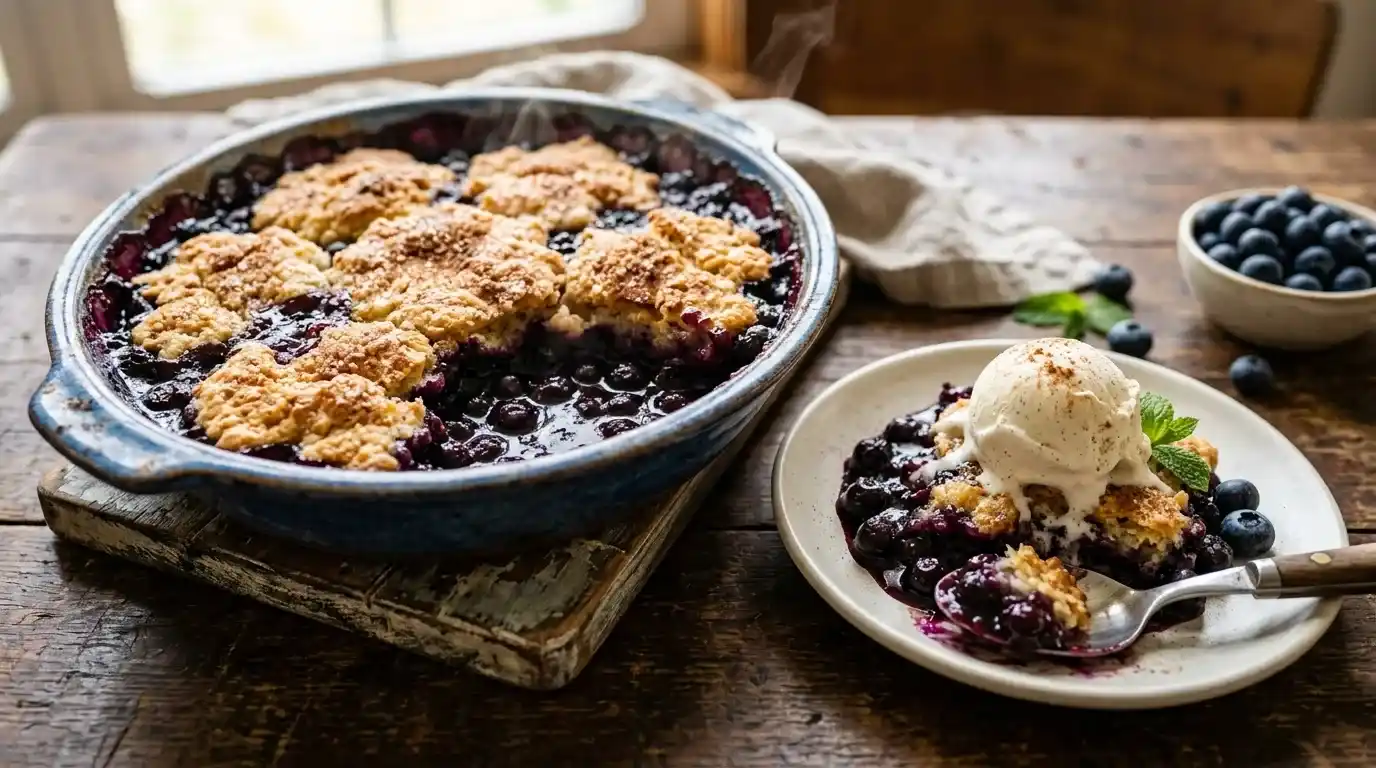
Blueberry Cobbler Recipes that stay thick and not watery use two things working together: cornstarch in the berry layer and a biscuit topping that rests directly on the berries rather than floating above them. The biscuit absorbs some of the thickened berry juice from underneath as it bakes, which is what gives the underside its characteristic soft, berry-stained texture while the top crisps and colours.
The second reason this version works is the ratio of topping to filling. Too much biscuit and the filling never heats through fully before the top is done. Too little and the filling dominates and the topping loses its structural purpose. The ratio here — roughly equal depth of filling and topping — gives you both layers fully cooked in the same window of time.
What You Need
For the Blueberry Filling
- 675 g (1½ lb / about 4½ cups) fresh or frozen blueberries
- 100 g (½ cup) caster sugar
- 1 tablespoon cornstarch
- 1 tablespoon fresh lemon juice (about ½ medium lemon)
- 1 teaspoon finely grated lemon zest
- Pinch of fine sea salt
For the Biscuit Topping
- 190 g (1½ cups) plain flour
- 50 g (¼ cup) caster sugar, plus 1 tablespoon for sprinkling
- 1½ teaspoons baking powder
- ¼ teaspoon fine sea salt
- 85 g (6 tablespoons) unsalted butter, cold and cubed
- 120 ml (½ cup) whole milk or buttermilk, cold
Optional: vanilla ice cream or cold double cream to serve

How to Make Blueberry Cobbler Recipes — Without Soggy Biscuits or Watery Filling
Phase 1: Make the Blueberry Filling
Blueberry Cobbler Recipes start with a filling that needs to be assembled and rested before the topping goes on — this matters for how the cornstarch distributes through the berries.
- Heat your oven to 190°C / 170°C fan / 375°F. Place a rimmed baking sheet on the rack below where the cobbler will sit.
- In a large bowl, combine the blueberries, sugar, cornstarch, lemon juice, lemon zest, and salt. Toss until every berry is coated and the cornstarch has dissolved into the juices — no white powder should be visible.
- Pour the blueberry mixture into a 23 x 33 cm (9 x 13 inch) baking dish or a 25 cm (10-inch) round baking dish at least 5 cm (2 inches) deep. Spread it evenly. Let it sit while you make the topping — this 5-minute rest helps the cornstarch begin working before the heat starts.
Phase 2: Make the Biscuit Topping
- Whisk the flour, sugar, baking powder, and salt together in a large bowl.
- Add the cold cubed butter. Work it in with your fingertips — press and flatten the cubes into the flour until the mixture looks like coarse breadcrumbs with some pea-sized butter pieces still visible. Those larger pieces are what create texture in the finished topping. Do not over-work; the butter should not fully disappear.
- Pour in the cold milk all at once. Stir with a fork just until the dough comes together into a shaggy mass — it should look rough and just barely hold when pressed. Over-mixing at this stage develops gluten and makes the topping tough.
- Drop the dough in rough spoonfuls across the blueberry layer. Leave gaps between them — the dough spreads and expands during baking, and gaps allow steam to escape from the berry layer below. If the dough is pressed together in one solid sheet, the filling steams rather than bubbles underneath.
- Sprinkle the remaining tablespoon of sugar evenly over the dough.
Phase 3: Bake and Rest
Blueberry Cobbler Recipes need a rest after baking — serve too soon and the filling will be thin and will not hold when spooned.
- Bake for 38–45 minutes. The topping is done when it is deep golden across the surface and the berry filling is visibly bubbling around the edges and between the biscuit drops. Bubbling filling is the done signal, not just topping colour.
- Remove from the oven. Let the cobbler rest for at least 20 minutes before serving. The filling continues to thicken as it cools — cutting into it immediately produces a runny, loose result that sets up properly given time.
- Serve warm with cold cream or ice cream. The contrast between the hot fruit layer and the cold topping is the point.
How to Fix It — Without the Same Problem Twice
PROBLEM: Your Blueberry Cobbler Recipes filling is thin and watery under the biscuit topping. CAUSE: The cornstarch was not enough for the volume of berries, or frozen berries were used without being thawed and drained first. FIX: If using frozen berries, thaw and drain off excess liquid before measuring. Increase cornstarch to 1½ tablespoons for frozen fruit. Always let the cobbler rest 20 minutes after baking — the filling thickens significantly as it cools.
PROBLEM: The biscuit topping is raw and doughy in the centre despite the top looking done. CAUSE: The topping was placed in one solid sheet rather than individual drops, trapping steam and preventing heat from reaching the centre. FIX: Drop the dough in separate spoonfuls with visible gaps between them. If this has already happened, cover loosely with foil and return to a 175°C / 350°F oven for 8–10 minutes.
PROBLEM: The biscuit topping is hard and dense rather than tender and slightly layered. CAUSE: The butter was too soft when worked in, or the dough was over-mixed after the milk was added. FIX: Use butter straight from the fridge, cut into small cubes. Mix after adding milk with as few strokes as possible — the dough should look rough and shaggy, not smooth.
PROBLEM: The filling overflowed the dish and burned on the oven floor. CAUSE: The baking dish was not deep enough, or too many berries were used relative to the dish size. FIX: Always place a rimmed baking sheet on the rack below. Use a dish at least 5 cm (2 inches) deep — a dish too shallow has nowhere to contain the bubbling filling.
How to Store It Without Losing the Texture
Cobbler keeps at room temperature, loosely covered, for up to 2 days. After that, refrigerate it — the topping softens slightly in the fridge but the flavour is still good for up to 4 days.
To reheat, place individual portions in a 175°C / 350°F oven for 10–12 minutes until the filling bubbles at the edge again. A microwave reheats the filling well but softens the biscuit topping irreversibly.
Cobbler does not freeze well once baked — the topping becomes gummy on thawing.

Estimated Nutrition Per Serving (serves 8)
| Nutrient | Per Serving |
|---|---|
| Calories | ~265 kcal |
| Total Fat | 10 g |
| Saturated Fat | 6 g |
| Carbohydrates | 42 g |
| Fibre | 2 g |
| Sugar | 24 g |
| Protein | 3 g |
| Sodium | 190 mg |
Figures are estimates. Values vary with exact ingredients and portion sizes.
Questions People Ask About This One
Can I use frozen blueberries instead of fresh?
Yes, but thaw them first and drain off as much liquid as you can — frozen berries release significantly more liquid than fresh. Pat them dry with paper towels before tossing with the cornstarch. Increase the cornstarch to 1½ tablespoons. The filling will still be slightly looser than a fresh-berry version, but resting the cobbler for the full 20 minutes after baking closes most of that gap.
Can I make this in individual ramekins instead of one large dish?
Individual ramekins work well and reduce the bake time. Use 8 x 250 ml (1-cup) ramekins. Divide the filling and topping evenly. Bake at the same temperature for 25–30 minutes until the topping is golden and the filling bubbles visibly. Place all ramekins on a single baking sheet to catch any overflow — individual dishes are just as likely to overflow as a large one.
Can I make Blueberry Cobbler Recipes with other fruit?
Blueberry Cobbler Recipes adapt to almost any stone fruit or berry. Peaches, cherries, and blackberries all work at the same ratios — tart fruits benefit from an extra tablespoon of sugar in the filling, while very sweet fruits like ripe strawberries can take less. For a cobbler that spans two fruits, replace up to half the blueberries with another berry. Check out our Peach Cobbler for how to handle a stone fruit version specifically.
Why does my biscuit topping sink into the filling during baking?
The biscuit dough was too thin, or the filling was too loose at the start. Make sure the dough holds together in a rough, cohesive mass when dropped — if it flows off the spoon like batter, it has too much milk and will sink. Add flour one tablespoon at a time until it drops in a shaggy, spoonable mass. A firm biscuit dough sits on top of the filling rather than sinking into it.
Closing
My son finished the entire dish before I had set out plates — and he is genuinely not someone who seeks out dessert or notices what is in front of him. Watching him scrape the dish twice told me that Blueberry Cobbler Recipes had found their permanent place in this kitchen. If you tried adding a pinch of cinnamon to the berry filling and found it changed the balance with the lemon, I really want to know whether you kept it — leave me a note below.

Blueberry Cobbler: Easy Homemade Dessert
Ingredients
Method
- Preheat the oven to 375°F (190°C).
- Grease a baking dish lightly with butter or cooking spray.
- Add blueberries, lemon juice, and ¼ cup sugar to a bowl and mix gently.
- Spread the blueberry mixture evenly into the baking dish.
- In another bowl, whisk together flour, remaining sugar, baking powder, and salt.
- Pour in milk, melted butter, and vanilla extract and stir until combined.
- Pour the batter evenly over the blueberries without stirring.
- Bake for 40 minutes or until the topping is golden brown.
- Remove from the oven and allow the cobbler to cool for 10 minutes.
- Serve warm on its own or with vanilla ice cream.
Video
Notes
- Frozen blueberries can be used without thawing.
- For extra flavor, add a pinch of cinnamon or nutmeg.
- Best served warm with whipped cream or vanilla ice cream.
- Store leftovers covered in the refrigerator for up to 3 days.